
The Anatomy of an Edge
A well-made kitchen knife announces its quality through the hand before it reveals it on the board. The edge enters an onion with a quiet, controlled bite, then glides through the layers without crushing them. A mass-market stamped blade often feels different: the handle may be light, the edge may skid across tomato skin, and greater pressure is needed to complete a cut. That contrast is not simply a matter of brand, polish, or appearance. It arises from blade geometry, heat treatment, and the microscopic structure created by the steel”s composition.
Carbon, chromium, vanadium, tungsten, molybdenum, and other alloying elements determine which phases form during heat treatment, how hard the finished blade can become, and how the edge responds to contact with food, board, and honing abrasive. A thin apex made from stable, finely structured steel can feel crisp and predictable for an entire prep session. A poorly treated or overly brittle edge may chip, roll, or lose its bite within minutes. Understanding that relationship turns knife care from guesswork into a practical extension of culinary technique. For broader comparisons of how modern steels balance retention, toughness, corrosion resistance, and sharpening effort, consult reputable blade steel comparisons before choosing a knife.
The Molecular Spice Rack of Blade Alloys
Carbon is the foundation of most hardened knife steels. During heat treatment, iron and carbon can transform into martensite, a hard, stressed structure that allows a thin edge to resist deformation. More carbon can support greater hardness and a keener apex, but only when the steel is properly heat treated. Excess carbon that is not dissolved into the matrix may instead contribute to carbides, which can improve wear resistance while also making sharpening and edge refinement more demanding.
Chromium has two important functions. At sufficient concentration, it improves resistance to oxidation by supporting the formation of a passive chromium-rich surface film. In high-alloy steels, however, chromium may also combine with carbon to form chromium carbides. This can reduce the chromium available for stainless behavior while increasing abrasion resistance. Tungsten, vanadium, and molybdenum likewise form hard carbides or influence transformation behavior. Vanadium carbides are especially hard and wear resistant, while tungsten and molybdenum can contribute to hot hardness, secondary hardening, and a durable fine structure. Powder metallurgy distributes these carbides more uniformly than many conventional production routes, which can improve the balance between sharpness, retention, and toughness.
| Element or feature | Primary contribution | Practical kitchen effect |
|---|---|---|
| Carbon | Martensitic hardness and carbide formation | Keener potential, stronger retention, but greater brittleness at high levels |
| Chromium | Corrosion resistance and chromium carbide formation | Lower maintenance in stainless grades, with possible sharpening resistance |
| Vanadium | Very hard, wear-resistant carbides | Long abrasive life and difficult stone work when carbide volume is high |
| Tungsten | Hard carbides and secondary hardening effects | Improved retention and a firm, refined cutting response |
| Molybdenum | Hardenability, corrosion support, and carbide formation | Useful balance of strength, retention, and environmental resistance |
The tactile result is a negotiation among these elements rather than a simple ranking. A low-alloy carbon blade may feel exceptionally lively because its fine matrix takes a keen, lightly toothy edge. A vanadium-rich powder steel may hold that edge longer but feel more deliberate on the stone and less forgiving if twisted in a dense squash. Steel guides such as the Kershaw steel reference illustrate why properties must be read together: edge retention, toughness, corrosion resistance, hardness, and sharpening ease are separate performance categories, not interchangeable labels.
Hardness and Heat Treatment Demystified
Rockwell C hardness, commonly written as HRC, measures resistance to a standardized indentation test. It is not a complete description of knife quality, but it offers a useful starting point. A blade around the low to mid 50s HRC tends to be comparatively forgiving and easy to sharpen. Many harder culinary steels fall in the upper 50s or low 60s, where a thinner edge can remain stable under suitable use. Standardized procedures for interpreting this measurement are described in the NIST Rockwell hardness guidance and this Authoritative Source.
Hardness must always be considered alongside geometry and heat treatment. A well-treated steel at 60 HRC with a thin, carefully supported edge can outperform a softer blade with poor geometry. Conversely, a hard blade with excessive retained austenite, coarse carbides, or an overly acute bevel may feel sharp initially but shed microscopic fragments under ordinary cutting. The useful question is not simply whether a knife is hard, but whether its hardness is appropriate for its edge thickness, cutting tasks, and maintenance routine.
- Rolling: The apex bends to one side, often producing a smooth snag or a reflective line visible under strong light. A few controlled passes on a fine ceramic rod may realign it if the steel is not too hard.
- Micro-chipping: The edge feels coarse or intermittently catches on paper and tomato skin. Magnification may reveal small bright notches. Repeated honing rarely fixes the cause; a stone must remove enough material to reach continuous steel.
- Premature dulling: The knife loses bite evenly across the edge, often indicating abrasion, a polished edge unsuitable for the task, or insufficient finishing work at the apex.
- Heat-treatment weakness: The knife may combine poor retention with unpredictable damage. Sharpening can improve the edge temporarily, but the underlying limitation remains.
There is a permanent trade-off between toughness and wear resistance. A tough steel tolerates impact and lateral stress, while a wear-resistant steel resists abrasive materials for longer. Hardness can improve edge stability and retention, but it narrows the margin for twisting, striking bones, cutting frozen food, or contacting glass and stone. Controlled testing, such as CATRA-style edge-retention work, is valuable because it standardizes load, edge geometry, and abrasive media, yet no laboratory result replaces correct cutting technique in a real kitchen.
Carbon versus Stainless in Active Culinary Practice
White Paper and Blue Paper steels belong to the high-carbon Japanese tradition. White steels are known for a very clean iron matrix and a remarkably responsive sharpening feel. On a whetstone, the slurry develops quickly, the burr forms clearly, and the finished edge can feel crisp and eager through herbs and ripe fruit. Their reactivity is equally clear: citrus juice, tomato water, onion residue, and damp storage can darken the surface rapidly. That patina is often welcomed as a living record of use, but red rust must be prevented through wiping, drying, and occasional food-safe oiling.
Blue steels add alloying elements, including chromium and tungsten, to improve retention and resistance to chipping while remaining reactive to varying degrees. Aogami Super extends that performance further through higher alloy content and careful heat treatment. These blades reward a cook who wipes between tasks and never leaves the knife in a wet sink. Stainless steels such as VG10, R2, and SG2 reduce daily maintenance, while powder metallurgy can provide a uniform carbide structure and high wear resistance. Yet stainless does not mean indestructible. Salt, acids, condensation, and neglected joints can still produce staining or pitting.
The manufacturing history behind these knives is equally instructive. Traditional blades were often built by forge welding a hard cutting steel to softer iron or steel, placing toughness behind the edge and making efficient use of costly material. Modern monolithic blanks, rolling processes, and powder metallurgy allow manufacturers to control composition and structure throughout the blade. Damascus describes a laminated or patterned construction rather than one universal steel grade, so the visible pattern should never be treated as a direct performance specification. Historical accounts of blade making and metal shaping can be explored through this cutlery history overview.
Tailored Whetstone Progressions for Distinct Alloys
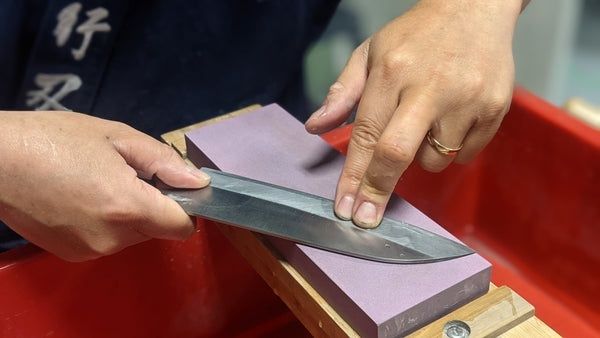
Abrasive choice should follow the steel, not fashion. Conventional synthetic waterstones are excellent for low-alloy carbon steels and many moderate-alloy stainless blades because they cut predictably and provide clear feedback through sound and slurry. Splash-and-go stones simplify professional routines where fast setup matters. Diamond plates and diamond emulsions are especially useful for high-vanadium steels, whose hard carbides can make softer abrasives feel slow or inconsistent. Hard-bonded ceramic stones and diamond abrasives also help maintain a flat sharpening surface and a clean apex on wear-resistant powder steels.
- Set the bevel on low-alloy carbon steel: Begin around 400 to 800 grit when repairing damage, or around 1,000 grit for routine sharpening. Establish a consistent angle on both sides and continue until a small, continuous burr can be felt from heel to tip.
- Refine without erasing useful bite: Move to approximately 2,000 to 3,000 grit for a practical kitchen edge. Use light pressure as the burr diminishes. For tomatoes, peppers, and fibrous herbs, stopping at this range often leaves a fine tooth that initiates the cut cleanly.
- Polish selectively: Progress to 5,000 grit or higher when a smooth push-cutting edge is useful for delicate produce or precise garnish work. Excessive polishing can reduce the aggressive bite that makes a working kitchen edge feel lively.
- Finish the apex: Alternate very light strokes, then deburr on clean stone or a carefully controlled leather surface. The edge should cut paper continuously and enter tomato skin without skating.
- Maintain powder metallurgy steels: Start with a diamond plate or hard abrasive when significant metal must be removed. Use a modest micro-bevel, often slightly more obtuse than the main bevel, to strengthen the apex and simplify future maintenance.
- Control pressure: High-alloy steels respond poorly to forceful, hurried sharpening. Let the abrasive work, keep the angle stable, and clean the stone frequently so loose swarf does not interfere with feedback.
For vanadium-rich steels, patience matters more than a long list of grits. A coarse diamond abrasive can establish the geometry, followed by a fine diamond or hard ceramic stone that reaches the carbide-rich edge without merely skimming the softer matrix. A small micro-bevel creates a compact support behind the apex, reducing the chance of chipping during contact with a board. The finished edge may not look mirror bright, and that is no defect. A clean, slightly toothy finish often glides through tomato skin and cooked meat more effectively than an over-polished bevel.
Sharpening technique must also respect the blade”s geometry. Hold the knife at a repeatable angle, lift the spine only enough to contact the intended bevel, and use the same number of controlled strokes on each side. Wipe the blade between grit changes so coarse particles do not contaminate a finer stone. After sharpening, rinse and dry the knife, then inspect the edge under a strong light. A continuous dark line indicates a refined apex; bright gaps usually indicate rolling, residual burr, or missed sections.
Mastering the Cut Through Mindful Craftsmanship
Alloy awareness becomes most useful when it changes daily behavior. Use end-grain or quality soft synthetic boards rather than glass, stone, or hard ceramic surfaces. Keep the cutting motion primarily vertical or forward through the food, avoiding twisting at the end of a cut. When portioning dense vegetables, make a deliberate opening cut instead of forcing the blade sideways. These habits protect both a delicate carbon edge and a highly wear-resistant stainless one.
Maintenance should be brief, consistent, and suited to the steel. Wipe acidic residue during preparation, wash by hand, dry immediately, and never leave a knife soaking or in a dishwasher. Carbon blades benefit from a thin food-safe oil film during storage, while stainless blades still deserve complete drying around the heel, bolster, and handle junction. Hone only when the edge has rolled, and sharpen when honing no longer restores bite. With the right steel, angle, abrasive, and board, the knife becomes more than a sharp object: it becomes a precise instrument whose feedback tells you when technique, maintenance, or material needs attention.