
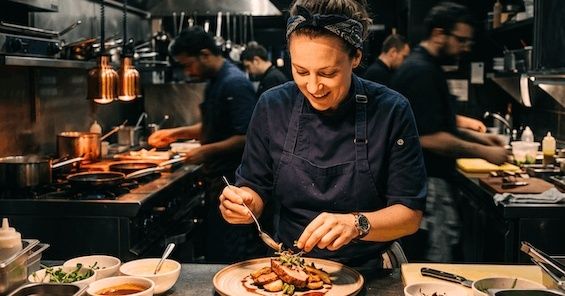
The Architecture of Heat and Order
Auguste Escoffier”s brigade de cuisine gave professional cooking a durable operating system. In the late nineteenth century, the French chef adapted military ideas of rank, discipline, and division of labor to the demands of large hotels and banquet kitchens. Stations such as the saucier, rôtisseur, entremetier, and garde-manger each carried a defined technical responsibility. The arrangement brought clarity to a crowded room where hundreds of covers might leave the kitchen in a narrow service window. A cook knew where to stand, which preparations belonged to the station, and whose instruction controlled the pass.
That order remains useful, but the modern dining room asks different questions. Menus change with hyper-seasonal produce, tasting courses require rapid pivots, and guests expect precise cooking even when the ticket rail surges without warning. Open kitchens also place the line in direct visual and acoustic contact with the dining room. A rigid chain of command can therefore become more than a structure. It can become a delay, particularly when information must travel through several layers before a practical adjustment reaches the pan.
The goal is not to discard specialization. Sauce work, butchery, pastry, fermentation, fire control, and garde-manger preparation still demand deep skill. The stronger model is a kitchen in which specialists retain ownership while also understanding the neighboring stations well enough to provide intelligent support. When cooks can move across defined zones, share sensory standards, and communicate without competing for authority, ticket flow becomes smoother, plates arrive at a more even temperature, and the work becomes more sustainable over a career.
The Escoffier Blueprint and Where It Fractures
Escoffier”s blueprint divided a complex production system into manageable units. The saucier handled sauces, reductions, and often sautéed items; the rôtisseur managed roasting and grilling; the entremetier covered vegetables, soups, and starches; and the garde-manger prepared cold dishes, salads, and hors d”oeuvres. In a banquet environment, this separation allowed large quantities to be prepared with repeatable methods. It also made training legible. A junior cook could master one group of techniques before advancing to a broader role.
The fracture appears when the volume pattern no longer matches the station map. If the rôtisseur receives a sudden wave of protein tickets while the entremetier has a quiet interval, strict boundaries leave useful hands underemployed. Meanwhile, the overloaded cook may be searing, basting, resting, slicing, and calling for garnishes simultaneously. The result is not merely slower service. It can produce uneven crust color, lost resting time, sauce held too long, or vegetables reaching the pass after the protein has cooled.
Compartmentalization can also separate the person cooking a component from the person tasting the finished plate. A sauce may be technically correct at the saucier”s range yet too reduced after it meets a salty garnish. A garnish cook may season by habit without seeing how the acid, fat, and protein interact in the final composition. The National Restaurant Association”s restaurant role guidance makes clear that job descriptions are generalized and should reflect an operation”s actual culture and responsibilities. That principle matters on the line: titles should clarify accountability without preventing practical collaboration.
| Operating feature | Rigid station model | Cross-trained station model |
|---|---|---|
| Prep distribution | Assigned by fixed specialty | Balanced according to forecast and live demand |
| Rush response | Neighboring stations may wait for direction | Signed-off cooks provide targeted backup |
| Quality control | Components may be judged in isolation | Teams evaluate the assembled plate |
| Staff development | Depth in one station | Depth plus transferable technical fluency |
| Operational risk | High when one person is absent | Lower when multiple cooks cover critical work |
Workplace sustainability also belongs in the calculation. A system that depends on one heroic cook repeatedly absorbing the hardest station may produce a fast service today while accelerating exhaustion, resentment, and turnover. Parallels in high-stress multidisciplinary action teams are well documented; as evaluated in this systematic literature review on collaborative leadership dynamics, shared leadership frameworks and horizontal coordination mitigate acute bottlenecks and support team resilience under intense operational pressure. The practical lesson is straightforward: throughput must be measured alongside recoverability. A kitchen that performs only when every specialist is present has not achieved resilience.
Designing Dynamic Kitchen Flow and Station Interdependence
Kitchen architecture influences communication before a single ticket is called. In an open kitchen, the pass is no longer a hidden boundary. Diners can see hesitation, hear conflict, and observe whether the team moves with calm precision. Theater cooking therefore requires communication that is concise and legible. A lead should not need to shout every instruction across the room. Clear sightlines, visible ticket status, deliberate handoff points, and predictable movement reduce the need for verbal force.
Modular cooking suites can reinforce this approach. Commercial heavy-duty modular suites from makers like Bonnet, Charvet, or Jade Range place burners, planchas, ovens, refrigerated drawers, and neutral plating surfaces within practical reach, reducing unnecessary steps and allowing adjacent cooks to assist without crossing dangerous paths. While luxury residential designs-such as the domestic range layout highlighted by Officine Gullo-borrow these ergonomic concepts to bring professional kitchen workflows into home cooking, restaurant lines demand rugged commercial suites engineered for continuous service volume. The underlying spatial logic remains identical: deliberate placement of heat, tools, landing space, and cold storage ensures support happens without interrupting primary station tasks.
A shared-zone model divides responsibility by function while keeping the boundary permeable. One cook may own protein searing, another the sauce and hot garnish, and a third the finishing surface. During a surge, the sauce cook can reduce a pan while the protein cook checks resting temperature, and a trained neighboring cook can plate garnish without waiting for a formal reassignment. This is controlled fluidity, not improvisation. Every movement requires a known standard, a safe route, and a clear point at which ownership returns to the primary station.
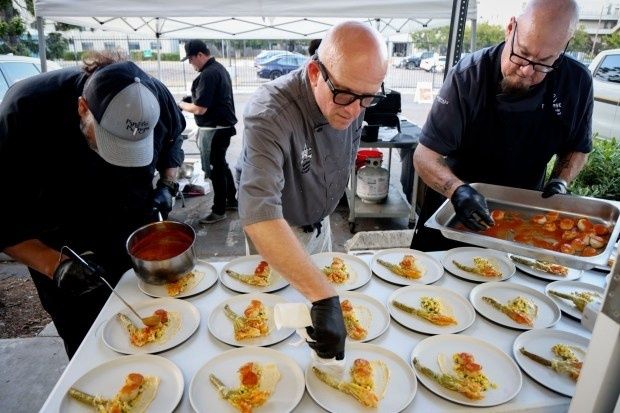
- Use visual ticket markers to show which components are fired, resting, held, or ready for the pass.
- Position backup tools and pans where an assisting cook can reach them without entering another cook”s heat zone.
- Use short call-and-response cues such as “fire,” “two minutes,” “walking,” and “hands” rather than continuous shouted commentary.
- Let sensory signals support the system: the crackle of a sear, the aroma of browned butter, and the visible sheen of a correctly mounted sauce all provide useful timing information.
Practical Protocols for Cross-Training the Modern Line
Cross-training should begin with vulnerability, not enthusiasm. Identify the station covered by the fewest genuinely competent people, then map the tasks that create the greatest service risk. A station may appear staffed on paper while only one cook can calibrate its fryer, judge its fish, or recover its sauce during a rush. The training objective is not to make every person interchangeable. It is to create dependable secondary coverage for the preparations that can stop the line.
- Build a dated skills matrix. Record each cook”s demonstrated level on each station, including whether the cook can prep, open, execute, close, and recover the station during a busy block.
- Pair one trainer with one learner. Begin during a low-volume service or controlled prep period. The learner should observe the complete sequence, from mise en place through breakdown, before taking discrete tasks.
- Teach the temperature curve. A backup cook must understand more than a recipe. Teach pan preheating, carryover cooking, resting, holding limits, and the visual cues for browning, reduction, and emulsification.
- Use staged shadow shifts. Start with garnish or replenishment, advance to one component, then combine components under supervision. Do not place a learner alone on a station that has not been formally cleared.
- Evaluate under real pressure. Sign-off should follow an unaided busy block, not a quiet demonstration. Record the date, the tasks completed, and any recovery skills still requiring practice.
Training must never weaken food safety. A cook moving from raw protein preparation to finishing work needs a designated handwashing sink, dedicated cutting boards and utensils, clean gloves when handling ready-to-eat foods, and a formalized sanitation reset. Allergen separation, cooling logs, active date-marking, and time/temperature control for safety (TCS) parameters must remain embedded in the station checklist rather than left to individual memory. In the United States, restaurants and retail food establishments are statutorily exempt from federal food facility registration; the FDA”s Registration of Food Facilities and Other Submissions guidance helps distinguish that registration framework from the food safety oversight, operational inspections, and sanitation standards governed instead by state and local public health departments enforcing jurisdictions modeled on the FDA Food Code. Cross-training expands line capability, but it must strictly reinforce local health codes, employee hygiene rules, and cross-contamination prevention controls.
A practical rotation might give each cook a primary station for the busiest service, a secondary station during a slower shift, and a scheduled shadow period each week. Rotate only one major position at a time when the menu is complex. Otherwise, the entire line loses its reference point. The chef should also protect the trainer”s workload. Training while both cooks are drowning creates false confidence, because the learner copies hurried movements without understanding the cues that make the station stable.
Use two or three reliable stations as a realistic development target for each person, then work toward at least three signed-off cooks for every critical station. Measure the program through observable outcomes: fewer single points of failure, reduced station-specific overtime, faster break coverage, cleaner handoffs, and consistent performance during the heaviest service block. If ticket throughput improves but plate quality falls, the training sequence is too broad or the sensory standards are not yet shared.
The Sensorially Unified Pass and Modern Communication
The expéditeur remains the kitchen”s timing authority, but the role is most effective when it resembles an orchestra conductor rather than a punitive barker. The pass should read the room, the ticket rail, and the food simultaneously. A strong lead sees that one table”s fish is ready while its sauce is still tightening, notices that another table requires a fresh garnish, and protects resting time instead of forcing every component to arrive at once. Authority becomes visible through anticipation and clarity.
Shared tasting is the foundation of that clarity. Before service, taste the principal sauce, broth, purée, pickle, and garnish as they will appear on the plate. Discuss whether the finish needs more acid, salt, bitterness, aromatic lift, or fat. Describe the result in sensory terms: the sauce should coat the spoon lightly, the purée should feel smooth rather than gluey, and the pickle should cut through the richness without dominating it. These benchmarks allow a cook to make a controlled adjustment rather than waiting for permission for every correction.
- Use a short pre-service palate calibration with the same tasting spoons and representative portions.
- Call timing in compact phrases, then require a clear acknowledgment from the responsible station.
- Check the plate from the guest”s perspective for temperature, sauce placement, visual balance, and accidental drips.
- Protect the pass from clutter so hot plates, cold garnishes, and completed tickets do not compete for the same landing space.
- When an error occurs, state the correction and the next action first; conduct the process review after the rush.
During peak service, tactile and visual checks often outperform extra speech. A cook can feel whether a plate is warming or cooling too quickly, see whether a sauce has split under pass lights, and hear when a pan has moved from a lively sear to dry heat. The communication system should make those observations easy to share. A calm “sauce needs thirty,” followed by an acknowledged “thirty,” is more useful than a stream of overlapping explanations.
Building Your Adaptive Brigade
Escoffier”s brigade supplied the essential grammar of professional kitchen organization. Its stations made specialization teachable and large-scale production possible. Modern kitchens can preserve that discipline while changing the relationships between stations. The strongest line combines deep craft with shared technical fluency, allowing a cook to remain accountable for a specialty while understanding how that specialty behaves in the complete dish.
Begin with a measured intervention rather than a wholesale restructure. Audit where tickets wait, where one person becomes indispensable, and where component quality drifts between station and pass. Then introduce a small, deliberate rotation and observe the results through both numbers and sensory review. An adaptive brigade should leave the kitchen with hot food still hot, sauces still vibrant, garnishes still crisp, and cooks still capable of returning tomorrow with concentration intact.
- Map current station silos and identify the most dangerous single points of failure.
- Schedule intentional shadow shifts during low-volume periods.
- Record dated sign-offs instead of relying on verbal confidence.
- Conduct shared palate calibration during every pre-service briefing.
- Review ticket flow, plate consistency, safety compliance, and staff fatigue together.